
A business not showing in ChatGPT is one problem. A worse one is appearing with the wrong service, an old location, a thin description, or a version of the company that stopped being accurate months ago.
Publishing another blog post will not automatically fix that.
The business already has a public record spread across its own pages, search profiles, review sites, directories, old URLs, and structured data. If those sources disagree, the first job is to find the conflict before adding more content.
BrandLyft’s LLM Search / AI SEO work starts from that foundation. The business needs clear facts that people can verify and machines can interpret without reconstructing the company from fragments.
Find the Wrong Answer Before You Fix the Website
Start with the actual output.
Ask the same business question in several forms. Search the company name first. Then ask what the company does and which areas it serves. Test the service that matters most. Try a category query a customer might use when comparing providers.
Save the answer and the cited sources when the tool provides them.
Do not begin by changing every page that mentions the business. First identify the specific fact that is wrong, missing, or unstable. A wrong location is a different problem from a missing service. An old company description has a different trail from a competitor earning citations for a question your own site barely answers.
The source list matters too. ChatGPT search can surface public websites and cite web sources when answering current questions. OpenAI also says public sites can appear in ChatGPT search when site owners allow OAI-SearchBot to access the content needed for summaries and snippets.
That does not mean allowing a crawler guarantees a mention. It means a correction cannot help a search system that cannot access the corrected page.
A Business Not Showing in ChatGPT May Have a Definition Problem
A company can describe itself in several ways without noticing the gaps.
The homepage calls it a restoration company. Service pages say water damage and mold remediation. An outdated About page still describes a general construction business. One location page focuses on roofing because that office offered it years ago. Google Business Profile uses another category. An old directory calls the company a remodeling contractor.
A person can often infer that the business changed over time. Those pages and profiles can remain available as separate public sources long after the business has moved on.
The fix is not to repeat one sentence everywhere.
Write down the current facts first. Use the exact business name people should recognize today. List the services the company actually sells and the locations that are real. Add the service areas the company supports, the type of customer it serves, and any old offers that have ended.
Those facts need to stay stable even when the wording changes from page to page.
Google’s current Organization structured-data guidance makes the same distinction at a technical level. Organization markup can identify details such as the company name, URL, phone number, address, logo, and external profiles. The markup helps only when those details describe the same organization people can see on the site.
Service Names Can Drift Without Looking Wrong
Service naming causes quieter problems.
A company might use “water restoration” on the homepage, “water damage restoration” on the main service page, “emergency water extraction” on a location page, and “flood cleanup” in an old article. Those terms may overlap, but they do not always mean the same service.
Variation is normal. Unclear boundaries are the problem.
The main service page should say what the company actually offers, who it serves, and any meaningful boundary around that service. Supporting pages can use natural variations without making the offer look like four unrelated businesses.
Watch for renamed services. A business may stop using an older label while the old page keeps ranking, receiving links, or appearing in search. Deleting the phrase from the navigation does not remove the old URL from the public record.
If the old service still exists under a new name, update the page and its internal links. If the offer is gone, decide whether the URL should redirect, remain for a valid historical reason, or leave the index. Do not let an abandoned page keep describing the company by accident.
Location Conflicts Are Easy to Create and Expensive to Ignore
Location information can drift after a move, expansion, franchise change, or service-area update.
The footer may show headquarters. Contact pages may show several branches. Location pages can contain old phone numbers. An About page may mention the city where the company started. Review profiles and directories may still display a previous address.
None of those facts is automatically wrong. The problem appears when a customer cannot tell what each location means.
A service business with one office and a wide service area should not make every city sound like a physical branch. A multi-location company should give each real location a stable name, address, phone number, and page when appropriate. Service-area language should describe where the company works without manufacturing offices that do not exist.
Google’s LocalBusiness documentation supports location-specific business details and recommends defining individual locations when a business has distinct physical locations. That markup should reinforce the visible page, not create a second version of the location.
If an AI answer names the wrong city, inspect the website before blaming the model. Check the contact page, location pages, footer, structured data, external profiles, old press mentions, and any indexed page that still pairs the brand with the outdated place.
The About Page Is Part of the Business Record
Many service-business About pages say almost nothing that another source can verify.
“Family owned.” “Customer focused.” “Quality service.” “Years of experience.”
None of that clearly identifies the company.
A useful About page should explain the business in plain terms. Name the company. State what it does. Show where it operates. Introduce real people when that supports trust. Mention meaningful history without leaving old positioning uncorrected. Link toward the services and locations that carry the detailed information.
Proof needs the same treatment.
A service page can claim commercial expertise while every case study shows residential work. The homepage can advertise a specialty that never appears in reviews, project examples, team information, or supporting content. That does not make the service false, but it leaves the website asking the reader to take the claim on faith.
BrandLyft’s AI SEO and LLM Search service focuses on this kind of entity and trust clarity rather than treating AI visibility as a keyword-count problem.
Do Not Let Structured Data Tell a Different Story
Structured data can clarify a page. It should not become a hidden correction layer for weak or outdated visible content.
Google’s structured-data guidelines say the markup should represent content visible to readers and should stay up to date. Organization markup can also help Google disambiguate a company and connect administrative details with its online presence.
That makes schema a useful audit point.
Compare the visible business name, phone number, address, URL, logo, organization type, and location details with the structured data actually rendered on the site. Check whether old plugins left duplicate Organization or LocalBusiness entities behind. Look for a previous address, retired social profile, old company name, or service type that the visible page no longer supports.
Fix the public page and the markup together.
Adding more schema properties will not repair a page that still gives the wrong answer in plain English.
AI Search Fact Check
Fix the business record before adding more content
BrandLyft’s LLM Search / AI SEO service checks website structure, business information, proof, and machine-readable signals before the team adds more AI-focused content.
Internal Links Tell Systems Which Pages the Site Treats as Important
A strong service page can sit almost alone.
Maybe it appears in the navigation, but no related articles link to it. Location pages mention the service without linking back. The homepage uses a broad “Services” link while the high-value specialty sits three clicks deeper. Older pages point to a retired version instead.
That weakens the site’s own explanation of what matters.
Google says it uses links to discover pages and as a relevance signal. Its link guidance also recommends logical site structure and descriptive internal anchor text.
For this diagnostic, follow the links around the business facts that AI keeps getting wrong.
If the company wants one page to be the main source for a service, other relevant pages should support that relationship. If a location page owns a specific local fact, the site should not keep sending internal authority toward an older duplicate. The goal is not to flood the site with links. It is to stop treating important pages like isolated documents.
Old URLs Can Keep an Old Version of the Company Alive
A redesign does not erase the previous website from the web.
Old service URLs may still return 200 status codes. Near-duplicate pages can remain indexable after a site rebuild. A former location may still have a page. A staging or alternate path may contain copied content. The current navigation can look clean while crawlers still reach older versions through links, sitemaps, or external references.
Google’s canonicalization documentation explains that Google may group duplicate or very similar pages and select one representative URL. Site owners can provide canonical signals, but those signals do not replace cleanup when two pages serve different jobs.
Review old URLs when the wrong AI description sounds suspiciously familiar.
Search the exact outdated phrase. Check which page still contains it. Inspect redirects, canonicals, sitemaps, and internal links. If the old page has no current purpose, resolve that instead of publishing a new article that says the opposite.
A correction works better when the old contradiction stops competing for attention.
External Profiles Should Confirm the Basics
The company website is the source it controls most directly, but it is not the only public description customers can encounter.
Google Business Profile, social profiles, review platforms, trade directories, partner pages, local chambers, press coverage, and industry listings may repeat business facts. Some will lag behind after a move, rebrand, acquisition, or change in services.
Do not try to make every profile use identical marketing copy.
Confirm the basics instead. The current business name should be recognizable. Real locations should match. The main category should not describe an offer the company dropped years ago. The website URL should point to the correct domain. Service descriptions should not directly contradict the pages customers reach after clicking.
Google’s Organization schema supports sameAs links to relevant external profiles. That can help identify the organization’s online presence, but it does not make an outdated profile accurate. The profile still needs correction at its source.
If you cannot edit a third-party listing, document it. Then strengthen the sources the business can control rather than inventing certainty about when an outside site will change.
Use a Fact Map Before You Publish More AI Content
When several contradictions appear at once, make the problem small enough to fix.
Create one working record for the facts that should remain stable across the business’s public presence. This is not a giant brand-message document. Keep it practical.
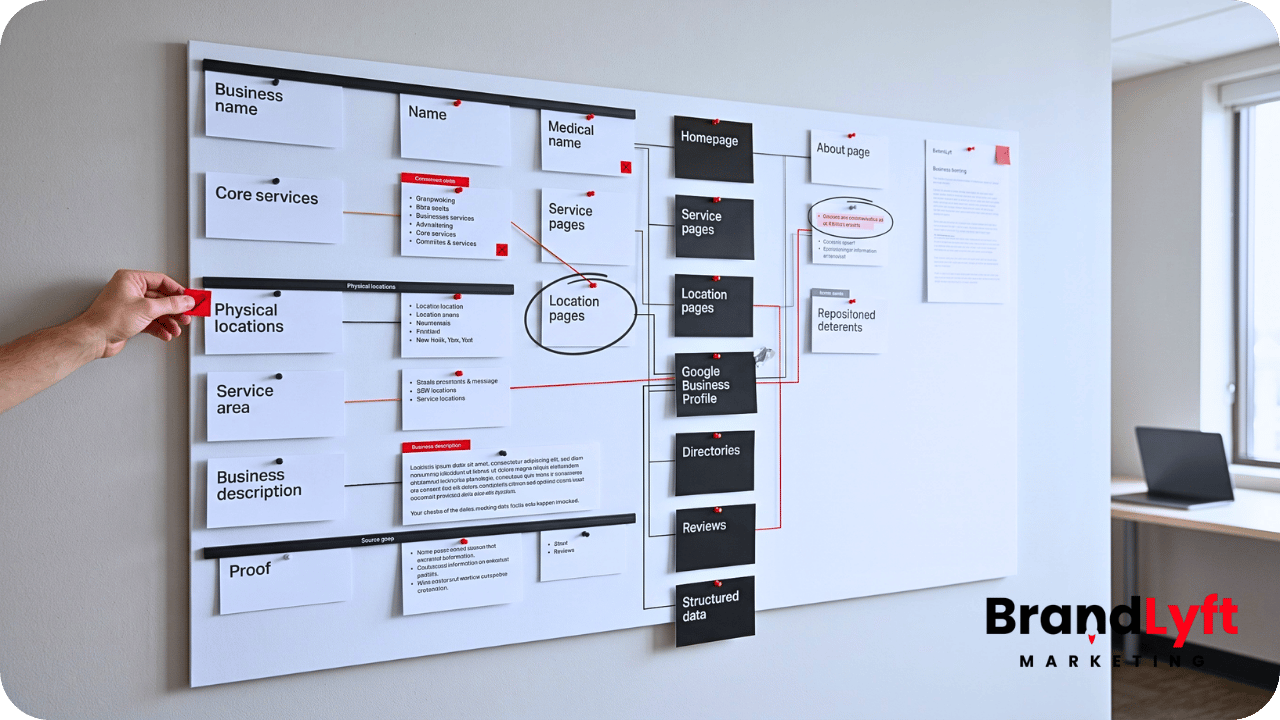
A practical fact map helps businesses trace conflicting public information before publishing more AI-search content.
| Business fact | Primary website source | Other places to verify | Common conflict |
|---|---|---|---|
| Business name | Home or About page | Profiles, schema, directories | Old brand name or inconsistent suffix |
| Core services | Main service pages | Homepage, profiles, reviews | Retired or vague service labels |
| Physical locations | Location and Contact pages | Local profiles, schema | Old address or fake-looking branch |
| Service area | Relevant service/location copy | Profiles and local pages | Physical location confused with coverage area |
| Business description | About page | Profiles, partner pages | Previous positioning still public |
| Proof | Case studies, team, reviews | External review sources | Claims unsupported by visible evidence |
Pick the page that should be authoritative for each fact. Fix that page first. Then work outward through the pages and profiles that repeat it.
This prevents a common reaction to AI visibility problems: publishing five new articles while the homepage, About page, schema, and location information still disagree.
Test the Correction as a Retrieval Problem
After the sources change, test again.
Use the same prompts that exposed the problem. Keep the wording and location context consistent enough to compare the answers. Check the cited sources. Search the corrected fact directly. Inspect whether the updated page is crawlable and indexable.
OpenAI says sites that want content included in ChatGPT search summaries and snippets should allow OAI-SearchBot. Google offers URL Inspection and a Request Indexing option for updated pages in Search Console. Neither action guarantees an AI answer will change on command.
Re-crawling, indexing, retrieval, source selection, and answer generation are separate events. A corrected page can exist before a search product has refreshed or selected it.
Track the test instead of declaring victory after one prompt.
Record the date, prompt, answer, cited sources, and the exact fact you are checking. Try again after the source changes have had time to propagate. If the wrong answer remains, look at the sources the tool still cites rather than immediately rewriting the correct page again.
AI Search Visibility Gets Easier to Diagnose When the Business Facts Stop Moving
A business not showing in ChatGPT does not automatically need more AI content.
Sometimes the company already has enough pages. The problem is that those pages do not describe the same current business clearly enough, or an older source still carries a version that should have disappeared.
Start with the wrong fact. Find where it appears. Correct the page that should own it. Bring the nearby website pages, structured data, and public profiles back into agreement where they genuinely conflict.
Then test again.
That work also supports normal search and human trust. A customer should not have to decide which address is real, which service name is current, or which version of the company to believe.
AI search is another place where those inconsistencies become visible.
AI Search Diagnostic
Start with the wrong answer, then trace the source
BrandLyft can review the pages, business information, and technical signals behind the issue before the team adds more content to the site.
Need the wider AI search service? Review LLM Search / AI SEO.