
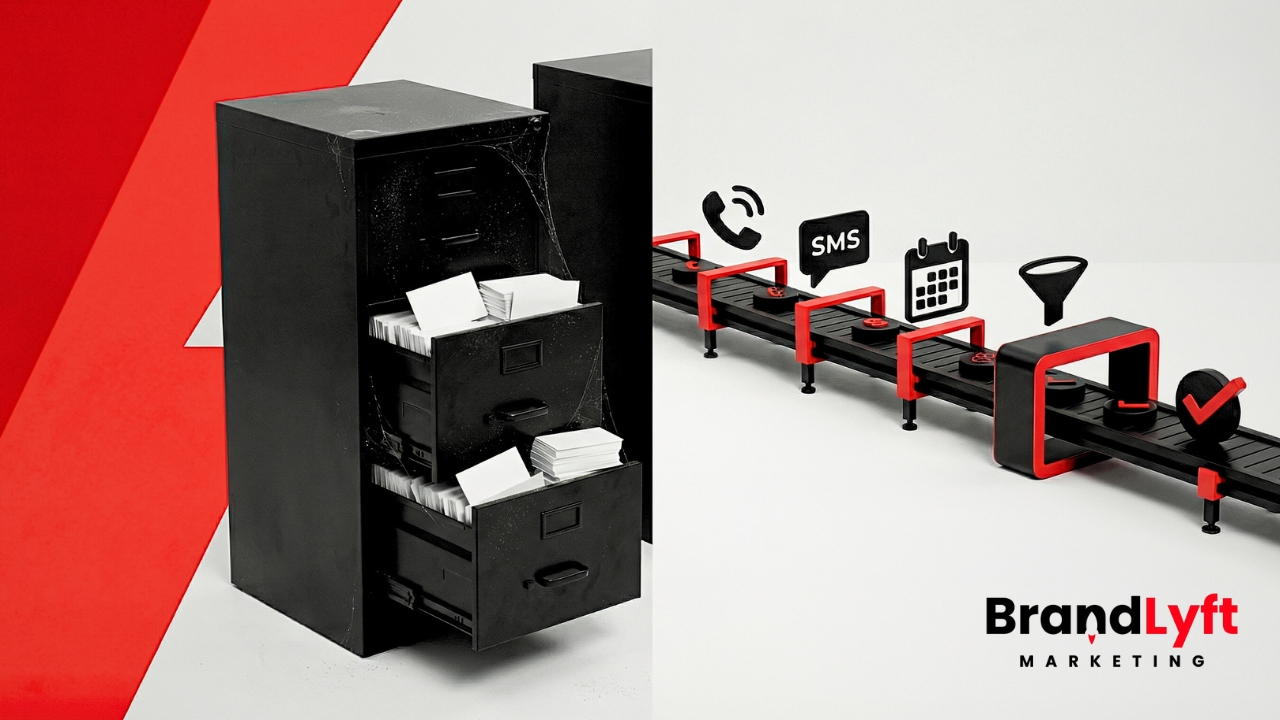
Most service businesses don’t fail with CRMs because of software. They fail because they never built a system. This is the difference – and how to fix it using GoHighLevel the right way.
The CRM Lie Most Service Businesses Believe
Let’s get this out of the way.
Buying a CRM does not fix your marketing.
Installing GoHighLevel does not create revenue.
And automations alone do not equal growth.
What most service-based businesses actually buy is hope.
Hope that leads will magically get followed up.
Hope that the team will “use the system.”
Hope that visibility will somehow appear.
But a CRM without a system is just an expensive database.
Here’s what we see all the time:
- Leads are coming in
- Calls are being missed
- Follow-up is inconsistent
- The owner is still the safety net
The problem isn’t GoHighLevel.
The problem is that nothing was designed.
A revenue system answers questions like:
- Who responds to a lead—and how fast?
- What happens if a call is missed?
- How many touches happen before a lead goes cold?
- Where does every opportunity live visually?
- What happens after the sale?
If your CRM can’t answer those questions automatically, you didn’t buy a revenue system.
You bought software.
The Difference Between “Using GHL” and Running a Revenue System
Most agencies “set up” GoHighLevel.
We architect systems on top of it.
Big difference.
Here’s what using GHL usually looks like:
- A funnel or two
- A basic pipeline
- Maybe a few automations
- Notifications sent to someone’s phone
- Fingers crossed 🤞
Here’s what a revenue system looks like:
1. Speed-to-Lead Is Engineered
Every lead – call, form, chat, ad – triggers an immediate response.
- SMS
- Call routing
- Calendar options
- Internal alerts
No waiting. No guessing. No “we’ll call them later.”
2. Follow-Up Is Relentless (and Human)
The system doesn’t ask if someone remembered to follow up.
It just does it.
Multi-touch. Multi-channel. Timed. Personalized.
Until:
- They book
- They say no
- Or they go cold (and get reactivated later)
3. Pipelines Drive Behavior
A pipeline isn’t for reporting.
It’s for action.
Each stage tells the team:
- What to do next
- When to do it
- Why it matters
No thinking required.
4. Visibility Is Built In
At any moment, the owner can see:
- New leads today
- Missed opportunities
- Open deals
- Follow-up performance
No Slack messages. No “can you pull a report?”
That’s not “using GHL.”
That’s running a revenue system powered by GHL.
How We Build Revenue Systems (Not CRM Setups)
This is where most agencies get it wrong.
They start with features.
We start with flow.
Step 1: Map the Money Path
Before touching automations, we map:
- How leads enter
- How sales happen
- Where things break
- Where money leaks out
This alone usually reveals 3–5 hidden problems.
Step 2: Design the System (On Paper First)
We define:
- Lead response rules
- Follow-up timelines
- Pipeline logic
- Ownership at each step
No tools yet. Just clarity.
Step 3: Build Inside GHL
Now we deploy:
- Calendars
- Pipelines
- Automations
- Missed-call text-back
- Web chat widgets
- AI-assisted responses where appropriate
Everything has a job.
Step 4: Stress-Test With Real Leads
We don’t assume it works.
We test it:
- Miss calls on purpose
- Submit fake leads
- Watch handoffs
If it breaks, we fix it.
A Simple ROI Example (Conservative on Purpose)
Let’s say a local service business gets:
- 100 leads/month
- Average job value: $750
Before a system:
- 60% contacted
- 30% booked
= 18 jobs → $13,500
After a revenue system:
- 90% contacted
- 45% booked
= 40 jobs → $30,000
Same traffic. Same ads.
Just a better system.
That’s a $16,500/month swing without spending another dollar on marketing.
This is why systems matter.